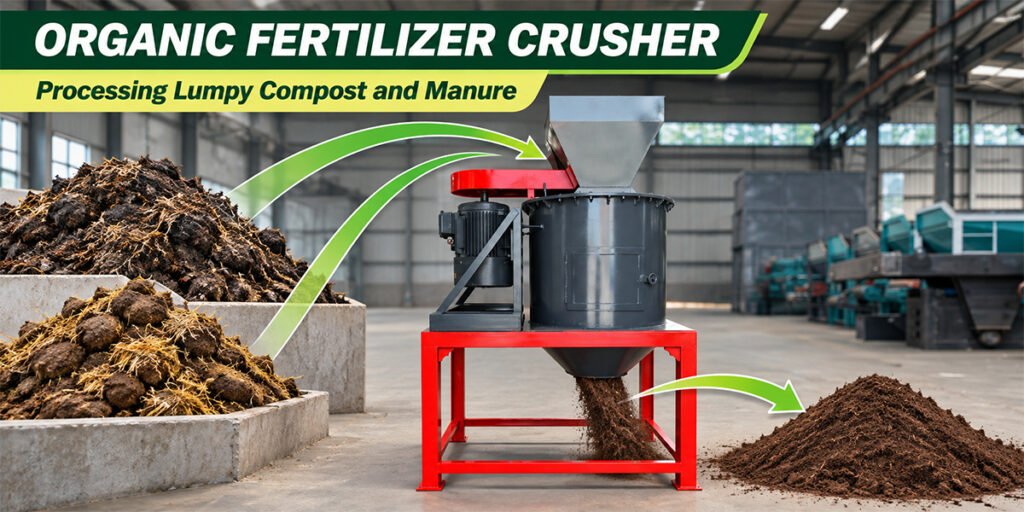
Wet manure and compost are difficult to crush because they often contain moisture, fibers, sticky particles, and uneven lumps. A standard dry-material crusher may block or produce inconsistent results when used with this type of feedstock.
An organic fertilizer crusher machine for wet manure is designed to reduce the size of composted manure and other organic waste before mixing, granulation, drying, or screening. The correct crusher depends on moisture content, fiber content, feed size, required output size, and production capacity.
Wet manure has different properties from dry fertilizer powder. The material may stick to the rotor, screen, or discharge outlet instead of breaking cleanly.
Common challenges include:
High moisture content
Long fibers from straw or bedding
Sticky compost particles
Large compacted lumps
Uneven feed size
Foreign materials such as stones or plastic
Moisture variation between batches
If the wrong crusher is selected, the production line may experience blockages, high motor load, excessive vibration, and unstable particle size.
What Does an Organic Fertilizer Crusher Do?
An organic fertilizer crusher reduces composted manure and other organic materials into smaller particles. The crushed material can then be mixed with nutrients, granulated, dried, screened, and packaged.
Crushing helps improve:
Material uniformity
Mixing quality
Granulation performance
Dryer efficiency
Screening accuracy
Final fertilizer appearance
Production stability
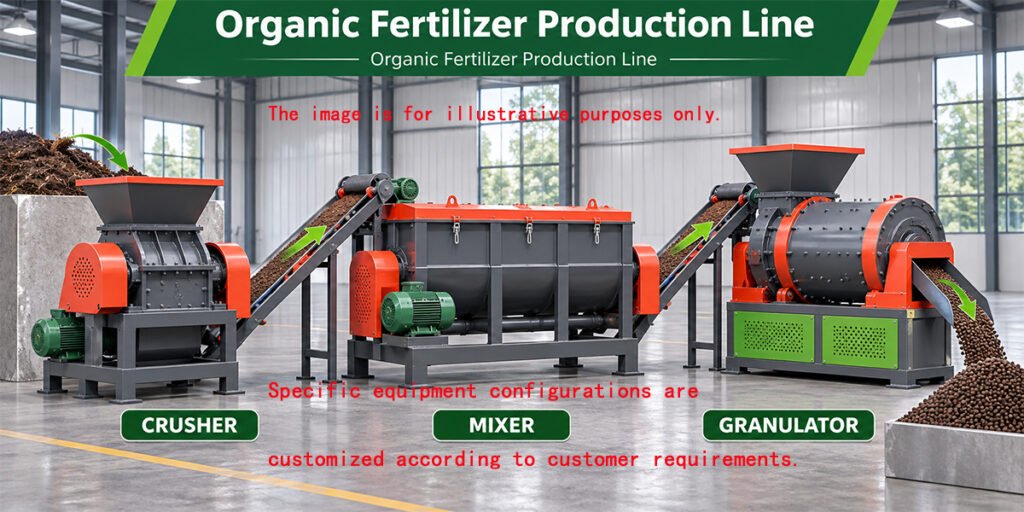
The crusher is usually installed after composting and before mixing or granulation.
Organic Fertilizer Crusher Working Process
A typical crushing process includes the following steps:
Wet manure or compost enters the feeding hopper.
A conveyor or feeding bin delivers the material at a stable rate.
Rotating crushing components break up lumps and reduce particle size.
Smaller particles pass through the discharge section.
Oversized material is returned for further crushing or screening.
The crushed material moves to a mixer, granulator, or dryer.
The actual crushing action depends on the machine design. Some crushers use chains, hammers, knives, cages, or vertical rotors to break the material.
Stable feeding is important. Feeding too much wet manure at one time may overload the motor and cause the inlet or discharge outlet to block.
Types of Crushers for Wet Organic Fertilizer
Semi-Wet Material Crusher
A semi-wet material crusher is commonly considered for wet compost, manure, sludge-based materials, and other sticky organic waste.
It may be suitable for:
Chicken manure compost
Cow manure compost
Pig manure
Poultry litter
Mushroom residue
Fermented food waste
Organic fertilizer returned from screening
The final selection should be based on actual moisture, fiber content, lump size, and required capacity.
The machine should be matched with a suitable feeding system to maintain stable operation.
Chain Crusher
A chain crusher uses rotating chains to break fertilizer and organic material into smaller particles. It may be used for selected organic fertilizer and compound fertilizer applications.
Chain wear should be inspected regularly because worn chains can affect crushing performance and output size.
Cage Crusher
A cage crusher is commonly used for relatively dry fertilizer materials and compound fertilizer mixtures. It may be less suitable for extremely wet and sticky manure unless the material has been properly pre-treated.
Hammer Crusher
A hammer crusher may be suitable for some dry or low-moisture organic materials. Wet manure can reduce its efficiency and increase the risk of sticking, so material testing is recommended before selection.
How to Choose a Crusher for Wet Manure
1. Check the Moisture Content
Moisture is one of the most important selection factors. Very wet material may need solid-liquid separation, composting, or pre-drying before crushing.
The manufacturer should know:
Initial moisture content
Moisture variation
Whether the manure has been composted
Required moisture after crushing
Whether drying follows the crusher
2. Evaluate Fiber Content
Straw, bedding, grass, and crop residues can increase fiber content. Fibrous material may wrap around crushing components or reduce output capacity.
When the material contains long fibers, the process may require:
Pre-cutting
Additional screening
A suitable crusher structure
Controlled feeding
Regular cleaning
3. Confirm the Required Particle Size
The required discharge size depends on the next step in the process. Material for mixing may have different requirements from material for granulation.
The expected output should be discussed before selecting the machine. A crusher that produces very fine powder may increase dust and energy use without improving the final fertilizer.
4. Calculate the Required Capacity
The crusher capacity should match the upstream and downstream equipment. If the crusher is too small, it becomes a production bottleneck. If it is much larger than necessary, the project may have unnecessary equipment cost.
Capacity calculations should consider:
Raw material volume
Operating hours
Moisture content
Bulk density
Feed size
Production schedule
Future expansion
5. Consider Maintenance and Wear Parts
Wet manure can increase wear and cleaning requirements. Before purchasing, confirm:
Access to wear parts
Cleaning method
Inspection points
Motor protection
Spare-parts availability
Maintenance support
How to Prepare Wet Manure Before Crushing
Correct preparation can improve crusher performance and reduce operating problems.
Remove Foreign Materials
Remove stones, metal, plastic, rope, glass, and other hard objects before feeding the crusher. Foreign materials can damage the rotor, chain, screen, and motor.
Compost the Manure
Composting can stabilize the organic material and reduce odor. Mature compost is usually easier to crush than fresh, sticky manure.
Reduce Oversized Lumps
Very large lumps should be reduced before entering the crusher. A stable feed size helps prevent overload and improves output uniformity.
Control Free Liquid
If the manure contains a large amount of free liquid, a solid-liquid separator may reduce the water load before crushing and drying.
Keep Feeding Stable
A feeding hopper, conveyor, or shovel feeding bin can help control the material flow. Sudden surges of wet manure should be avoided.
Common Problems and Solutions
Problem
Possible cause
Recommended action
Inlet blockage
Lumps are too large or too wet
Pre-treat the material and reduce feed rate
Material sticks to the rotor
Excess moisture or sticky compost
Improve composting or moisture control
Motor overload
Excessive feeding or foreign objects
Stop the machine and inspect the feed
Uneven particle size
Unstable feeding or worn parts
Stabilize feeding and check wear parts
Low capacity
High moisture or excessive fiber
Adjust pre-treatment and machine selection
Excessive dust
Material is too dry or over-crushed
Adjust crushing conditions and add dust collection
High vibration
Unbalanced rotor or foreign material
Stop operation and inspect the crusher
Frequent cleaning
Material is too wet or sticky
Improve moisture control and cleaning access
Crusher Position in an Organic Fertilizer Production Line
A wet manure fertilizer line may use the following process:
The exact sequence may change according to raw material and product requirements.
A complete line may include:
Feeding hopper
Solid-liquid separator
Compost turner
Organic fertilizer crusher
Horizontal mixer
Organic fertilizer granulator
Rotary drum dryer
Rotary cooler
Screening machine
Fertilizer packaging machine
Conveyor system
Dust-collection equipment
Electrical control cabinet
The crusher should be designed as part of the complete process rather than purchased as an isolated machine.
How to Improve Crushing Efficiency
To improve performance:
Keep the feed rate stable.
Remove foreign materials before feeding.
Avoid feeding oversized wet lumps.
Check moisture regularly.
Match the crusher to the material type.
Inspect chains, hammers, screens, and other wear parts.
Keep the discharge outlet clear.
Use a suitable dust-collection system.
Coordinate crusher capacity with the granulator and dryer.
Clean the machine according to the operating schedule.
Crushing efficiency should be evaluated together with particle size, energy use, maintenance frequency, and downstream production quality.
What Information Is Needed for a Crusher Recommendation?
To receive a suitable recommendation, provide:
Raw material type
Moisture content
Fiber content
Average lump size
Required particle size
Expected hourly capacity
Daily operating hours
Upstream process
Downstream process
Available workshop space
Local electricity conditions
Installation location
A material sample or video can also help the manufacturer evaluate stickiness, flowability, and crushing performance.
Frequently Asked Questions
What is the best crusher for wet cow manure?
A semi-wet material crusher is often considered for wet cow manure and compost. The correct choice depends on moisture, fiber content, lump size, and required capacity.
Can fresh manure go directly into a crusher?
Fresh manure may require pre-treatment because it can be very wet, sticky, and fibrous. Composting, dewatering, or pre-drying may improve the crushing process.
Why does the crusher keep getting blocked?
Common causes include excessive moisture, oversized lumps, foreign objects, unstable feeding, and an unsuitable crusher type.
Should manure be dried before crushing?
Not always. Some crushers are designed for semi-wet material. However, extremely wet manure may need dewatering or drying before crushing.
Can the crusher be used in a complete fertilizer production line?
Yes. The crusher can be connected with composting, mixing, granulation, drying, screening, and packaging equipment according to the project requirements.
Conclusion
Choosing an organic fertilizer crusher machine for wet manure requires more than comparing motor power or advertised capacity. Moisture, fiber content, lump size, required particle size, feeding conditions, and downstream equipment all affect the result.
A suitable crusher can improve the uniformity of composted manure, reduce granulation problems, and support stable fertilizer production. For very wet or sticky material, proper composting, dewatering, feeding, and moisture control are just as important as the crusher itself.
Organic fertilizer granulator is a machine specifically designed to process organic materials into organic fertilizer granules. Its main uses include but are not limited to the following aspects: The organic fertilizer granulator can convert organ...
A fertilizer dryer is a machine that removes excess water from your fertilizer granules. You need this machine to make a high-quality product. After granulation, fertilizer often has a moisture content of 30-40%. A dryer brings this down to a safe...
You have a large amount of organic waste, like animal manure or agricultural straw. You know it can be turned into valuable fertilizer. But piling it up and waiting for nature to take its course is slow, smelly, and inefficient. At Fude Machinery,...
In contemporary agriculture, the production of high-quality fertilizers is essential for enhancing soil fertility and boosting crop yields. Lime-based fertilizers, derived from natural materials like limestone, lime rock, and lime powder, serve as...
 Organic fertilizer equipment,organic fertilizer production line,organic fertilizer equipment factory