Running an organic fertilizer plant means handling wet, sticky raw materials such as manure, compost and sludge. Semi-wet material grinding is critical for smooth production. Fude Machinery’s guide explains its working principles and benefits for efficient, profitable operation.
Why Does Standard Equipment Fail at This Task?
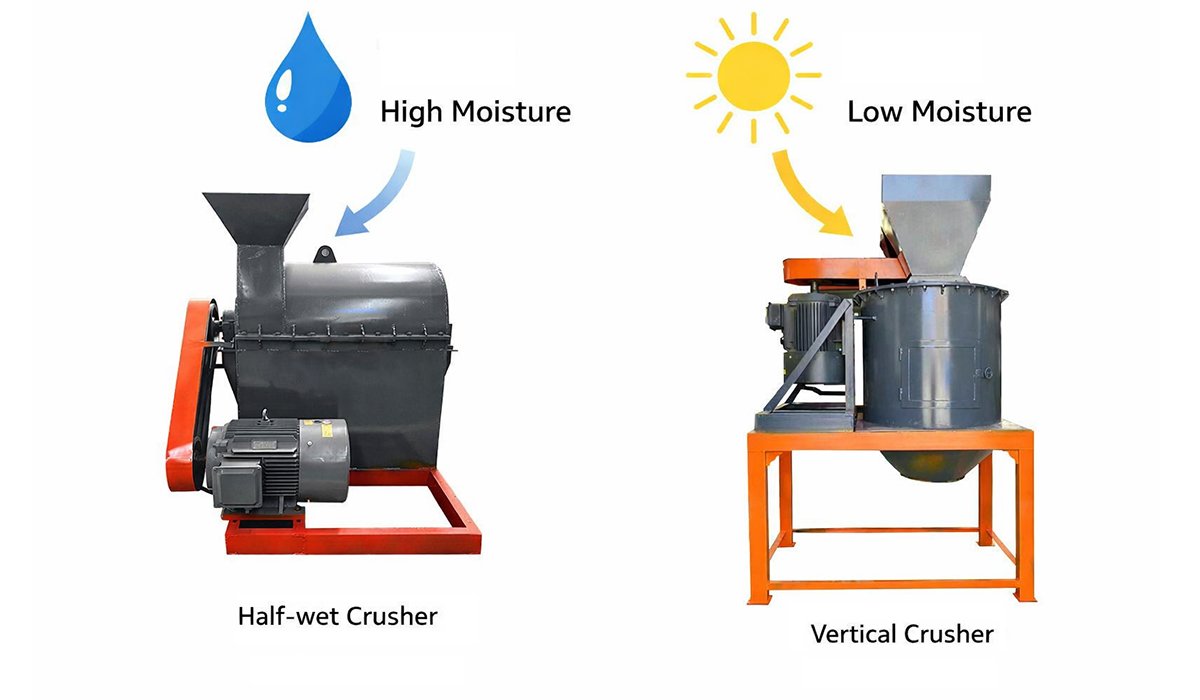
Conventional grinders are built for dry materials and easily clog with wet, sticky organic matter. Standard hammer mills rely on mesh screens, which get blocked quickly by high-moisture compost, halting production. Semi-wet grinding adopts a specialized design to solve this issue.
What Is the Technology Behind Clog-Free Grinding?
This clog-free semi-wet grinder features a screenless dual-rotor structure. Two high-speed counter-rotating rotors fully crush wet materials, serving as the core of modern organic fertilizer production gear.
This technology operates as follows:
Two rotors with hammers rotate in opposite directions at high speed.
Wet lumps get pulverized mid-air by dual-sided impacts.
Screenless design enables smooth discharge to the conveyor.
This process is continuous and incredibly efficient. It does not matter how wet or sticky your material is. Without a screen, there is simply nowhere for it to build up and cause a blockage.
How Does It Turn Lumpy Waste into Fine Powder?
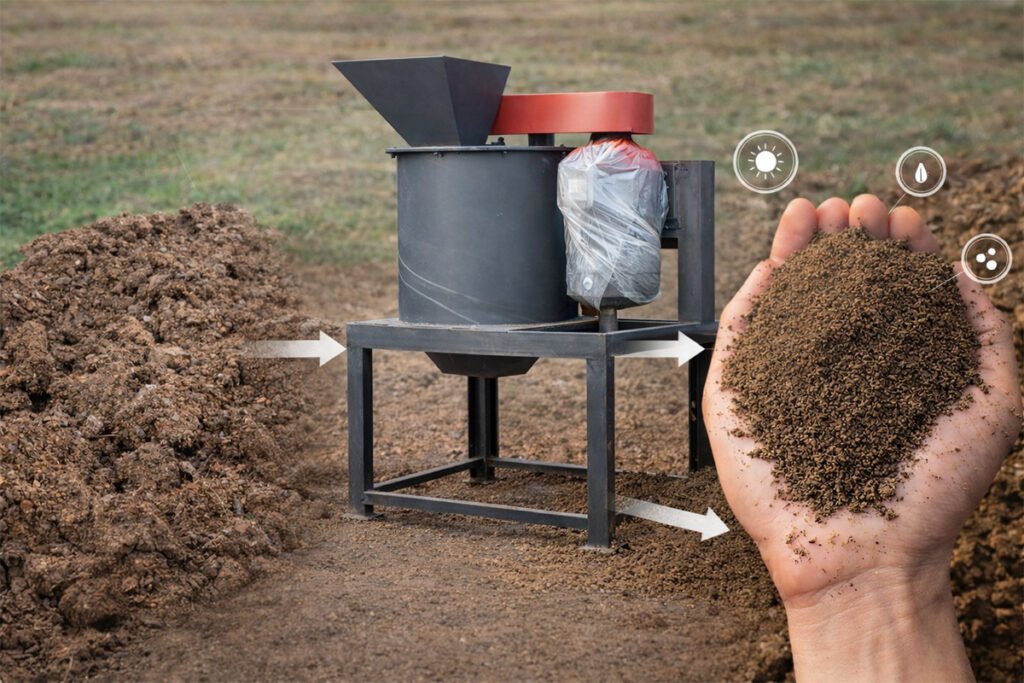
The process of semi-wet material grinding transforms inconsistent, lumpy organic waste into a uniform, fine powder through thousands of high-velocity impacts per minute. This transformation is critical for the quality of your final fertilizer product. You cannot make good, consistent granules from lumpy material. The grinder acts as the great equalizer, ensuring everything that passes through it has the same fine texture.
Think about the journey of a single clump of composted manure. It enters the top of the grinder as a solid, uneven mass. Instantly, it is shattered by the first set of hammers. These pieces are then thrown into the path of the second rotor, where they are struck again and broken down even further. This violent, chaotic process continues until the particles are so fine that they simply fall out of the open bottom. The result is a powder with a consistency similar to flour. This powder is now perfectly prepared for the next step in your production line, such as mixing or feeding into a fertilizer granulation machine.
Grinding vs. Crushing: What Is the Difference?
In the world of organic fertilizer manufacturing equipment, the terms “grinding” and “crushing” are often used to describe the exact same process for wet materials. This can be confusing for new producers. Traditionally, crushing refers to breaking large rocks into smaller pieces, while grinding refers to reducing smaller pieces into a fine powder. However, when dealing with wet organics, the machine that performs this task does both jobs at once.
Our official product name for this machine is a Semi-Wet Material Crusher. But its function is high-performance semi-wet material grinding. Do not get too caught up in the name. The important thing is the function and the technology.
Terminology
Traditional Meaning
In the Context of Wet Organics
The Key Takeaway
Crushing
Breaking large, hard objects (rocks)
The initial breaking of large, wet clumps
Both actions happen inside the same machine. It breaks down large lumps and reduces them to a fine powder simultaneously.
Grinding
Reducing small particles to powder (grain)
The final pulverization into a fine, uniform texture
The screenless, dual-rotor design is the essential feature, regardless of what you call the machine. It is the only way to achieve it.
How Can You Get a Machine Built Just For You?
As a direct manufacturer, Fude Machinery can build and customize your semi-wet material grinding equipment to perfectly match your production needs. This is a significant advantage over buying a standard, off-the-shelf machine from a trading company. Our 15 engineers and 8,000 square meter workshop give us the flexibility to create a tailored solution that will perform better and last longer in your specific environment. This factory-direct model also means you get a more competitive price.
We work with you to customize several key aspects:
Capacity and Power: We build machines for outputs from 1 ton per hour to over 20. We will match the motor size to your exact throughput requirements and your local power grid.
Material Durability: Our standard hammers are made from wear-resistant high-manganese steel. If you process materials with high sand or grit content, we can use even harder alloys for extended service life.
Seamless Integration: We can modify the inlet and outlet chutes to connect perfectly with your existing conveyors or to fit the bucket size of your wheel loader.
Our goal is to provide organic fertilizer manufacturing equipment that is not just a product, but a complete, one-stop solution for your business.
Frequently Asked Questions
Question 1: What exactly is semi-wet material grinding? Semi-wet material grinding is the process of pulverizing organic materials with high moisture content (20-50%) into a fine powder. It requires specialized organic fertilizer manufacturing equipment, specifically a screenless grinder, to prevent the constant clogging that occurs with standard machines.
Question 2: Why can’t I use a standard grinder for wet compost? Standard grinders use a screen at the bottom to control particle size. Wet, sticky compost will immediately plaster over this screen, causing a complete blockage. This leads to constant downtime for cleaning. A semi-wet grinder is screenless, so it cannot clog.
Question 3: Is there a difference between a grinder and a crusher? In the context of semi-wet organic materials, the terms are often used for the same machine. Both refer to the process of reducing lumpy, wet material into a fine powder. We refer to our machine as a Semi-Wet Material Crusher, but its function is high-efficiency grinding.
Question 4: What is the main benefit of buying this equipment from a manufacturer like Fude Machinery? Buying directly from our factory gives you two key advantages: a more competitive price and the ability to customize the equipment. Our engineers can modify the machine to match your exact capacity and material needs, ensuring you get the most efficient and reliable solution.
Summary and Recommendations
The process of semi-wet material grinding is the foundation of any successful organic fertilizer business. It is the step that turns challenging, inconsistent raw materials into a valuable, uniform feedstock. The key to this process is using the right organic fertilizer manufacturing equipment—a grinder with a screenless, dual-rotor design. This technology is the only reliable way to avoid the costly downtime caused by clogging.
Do not let the wrong machine dictate your production schedule. At Fude Machinery, we build the right machine. We are committed to providing durable, customizable, and competitively priced equipment directly from our factory. An investment in the correct grinding technology is an investment in the efficiency and profitability of your entire operation.
About Fude Machinery
We are Fude Machinery, a specialist B2B manufacturer of organic fertilizer equipment based in Zhengzhou, China. Since our founding in 2015, we have focused on providing factory-direct, customizable solutions to clients in over 120 countries. Our 8,000 m² workshop and team of 15 dedicated engineers ensure every machine we build is robust, reliable, and perfectly suited to our customer’s needs.
Are you ready to solve your grinding problems for good? Contact our expert team today for a free consultation and a detailed quote on a machine built for your success.
Cow manure, long regarded as a "waste product" in livestock farming, has emerged as a valuable resource in sustainable agriculture. Rich in nitrogen, phosphorus, potassium, and organic matter, it is an ideal raw material for organic fertilizers. H...
Organic fertilizer drum screening machine is a commonly used screening equipment in organic fertilizer production, and its main functions include the following aspects:
If you produce organic fertilizer, you face a common problem every day. Your raw materials, whether it is composted animal manure, agricultural waste, or municipal sludge, are never uniform. They are lumpy, sticky, and difficult to handle. An orga...
In the flourishing agricultural sector, the demand for high – quality biofertilizers is on the upswing. A 5 t/h powdery biofertilizer production line serves as an efficient solution for manufacturers striving to meet this burgeoning need...
 Organic fertilizer equipment,organic fertilizer production line,organic fertilizer equipment factory