For fertilizer manufacturers, raw material crushing is a vital first step, so picking the right crusher matters greatly. A poor choice leads to frequent blockages, downtime losses and inferior products. Since 2015, Fude Machinery has supplied reliable crushers to clients across 120+ countries. This guide introduces mainstream models to help you find the ideal unit for your plant.
Why Is Choosing the Right Fertilizer Crusher So Important?
Choosing the right fertilizer crusher is the foundation of an efficient and profitable production line. Your entire process, from mixing to granulation, depends on having a raw material that is consistently fine and uniform. If your crushing stage is unreliable, everything that follows will be a struggle. A crusher that is poorly matched to your material will constantly break down or clog. This stops production and forces your team to waste hours on cleanup and repairs.
A reliable crusher is the foundation of fertilizer production. It operates steadily to deliver uniform fine powder, boosting output and product quality. Choosing wisely avoids future troubles and revenue losses.
The Most Important Question: Is Your Material Wet or Dry?
Before you look at any specific fertilizer crusher, you must answer one question: what is the moisture content of your raw material? This is the single most important factor that will determine which type of machine you need. All crushers fall into one of two categories: those designed for wet materials and those designed for dry materials. Using a dry-material crusher for wet material is the most common and costly mistake we see new producers make.
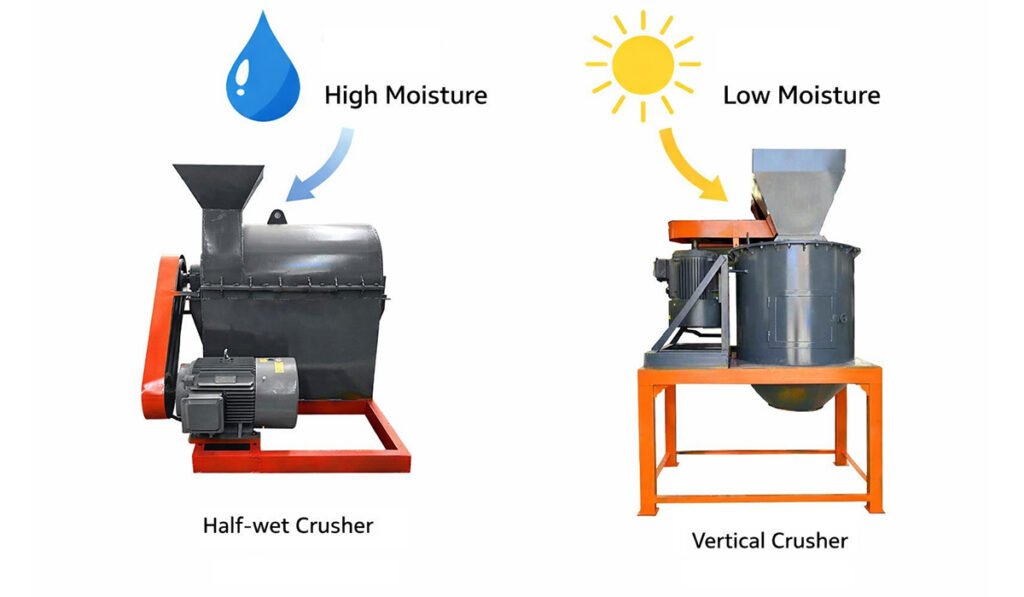
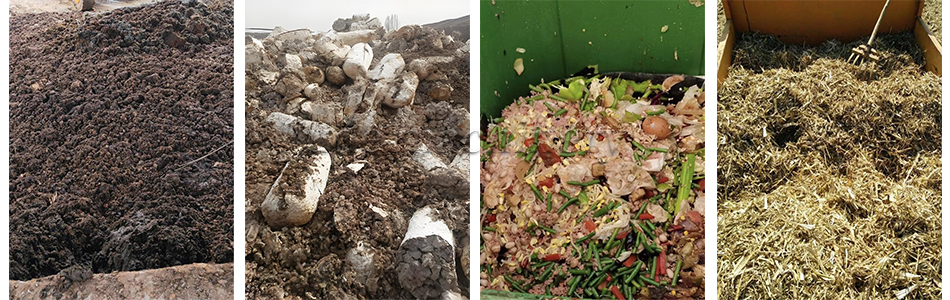
Wet Materials (20-50% Moisture): This includes fresh animal manure, raw compost, municipal sludge, and food waste. These materials are sticky, lumpy, and will instantly clog any machine with a screen.
Dry Materials (<15% Moisture): This includes things like dried compost, bentonite, chemical powders, and other brittle substances. These materials are not sticky and will crumble easily.
Answering this question honestly will immediately narrow your choices by half. It will prevent you from buying a machine that is guaranteed to fail in your specific application. Every fertilizer crusher we build is designed for a specific moisture range.
For Wet & Sticky Materials: The Semi-Wet Material Crusher
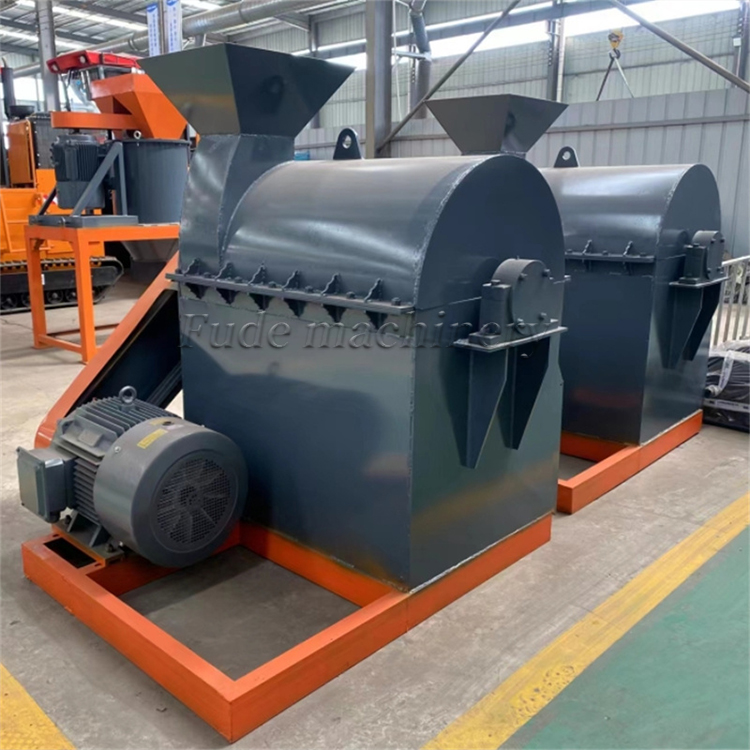
If you are processing wet, sticky organic matter, the Semi-Wet Material Crusher is the only reliable choice. This machine is a specialized piece of equipment engineered to do one thing perfectly: pulverize high-moisture materials without ever clogging. Its secret is a simple but brilliant innovation—it has no screen at the bottom. Standard crushers use a screen to control output size, but this is exactly what clogs with wet material.
Our Semi-Wet Material Crusher uses a dual-rotor system. Two sets of high-speed hammers spin in opposite directions, pulverizing the material in mid-air. The fine powder then falls straight through the open bottom.
Best For: All types of fresh manure, compost from a compost turner machine, sewage sludge, biogas residue.
Key Advantage: It is virtually impossible to clog. This ensures continuous operation and maximum uptime.
How it Works: Dual rotors smash material in mid-air, and the screenless design allows for free discharge.
This machine is the workhorse of the organic fertilizer industry. It is the correct foundational fertilizer crusher for almost every producer starting with raw organic waste.
For Dry & Brittle Materials: The Hammer Mill Crusher
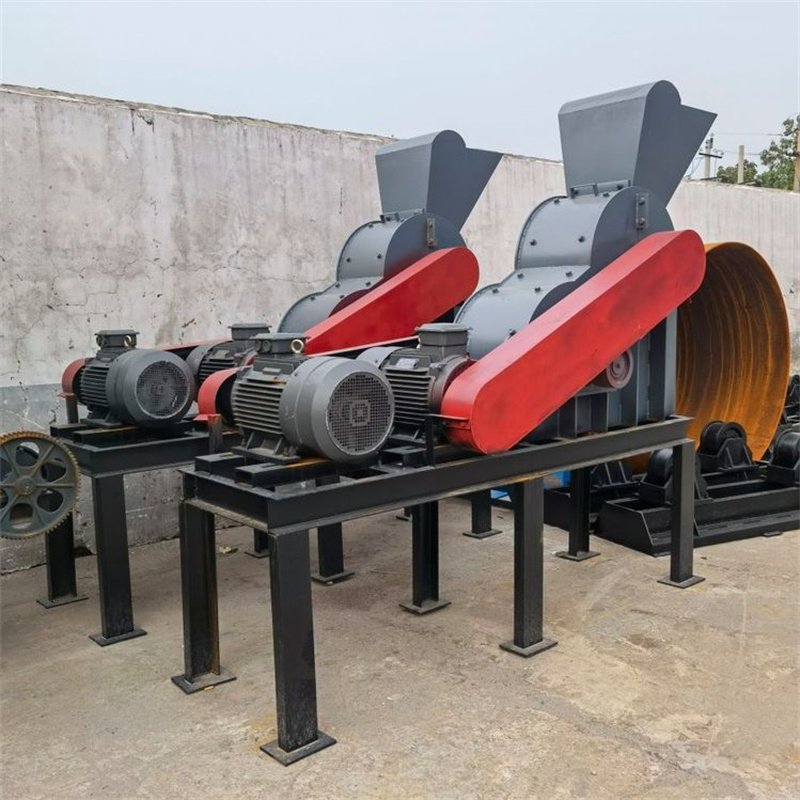
If your material is very dry and brittle, a Hammer Mill Crusher is an efficient and cost-effective option. This is a more traditional type of crusher that works exceptionally well for materials with a moisture content below 15%. The Hammer Mill operates with a single high-speed rotor that has swinging hammers. These hammers shatter the dry material against the inside walls of the grinding chamber.
The key feature of a Hammer Mill is the perforated screen at the bottom. The material stays in the chamber until it is ground fine enough to pass through the holes in this screen. This is excellent for precise particle size control, but it is also why it will instantly clog with any wet material.
Best For: Dried animal manure, dry chemical powders, bentonite, and other non-sticky, brittle materials.
Key Advantage: Excellent control over the final particle size. It is also a very simple and economical design.
How it Works: A single rotor with hammers shatters material until it is fine enough to pass through a bottom screen.
For producers making BB fertilizer or working with pre-dried inputs, this fertilizer crusher is an excellent choice.
For High-Volume Composting: The Vertical Crusher
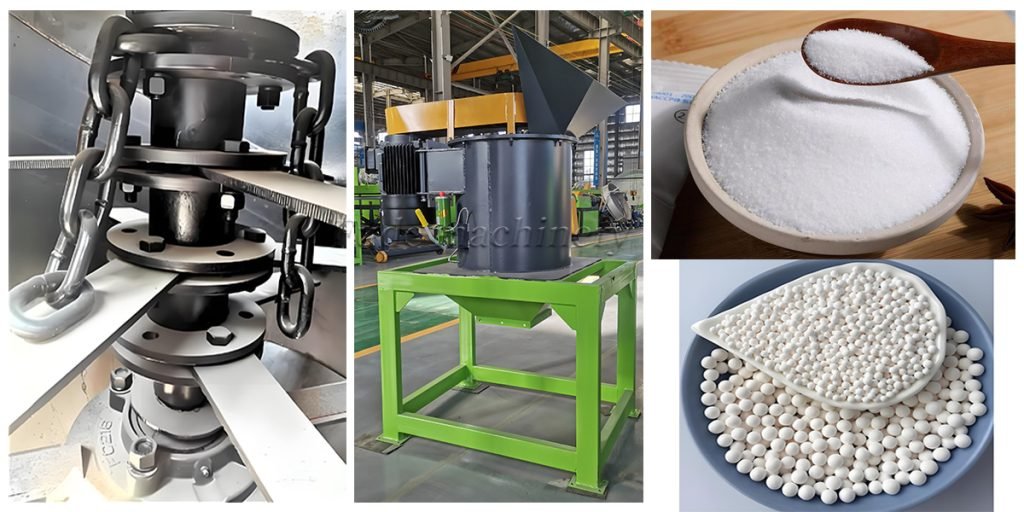
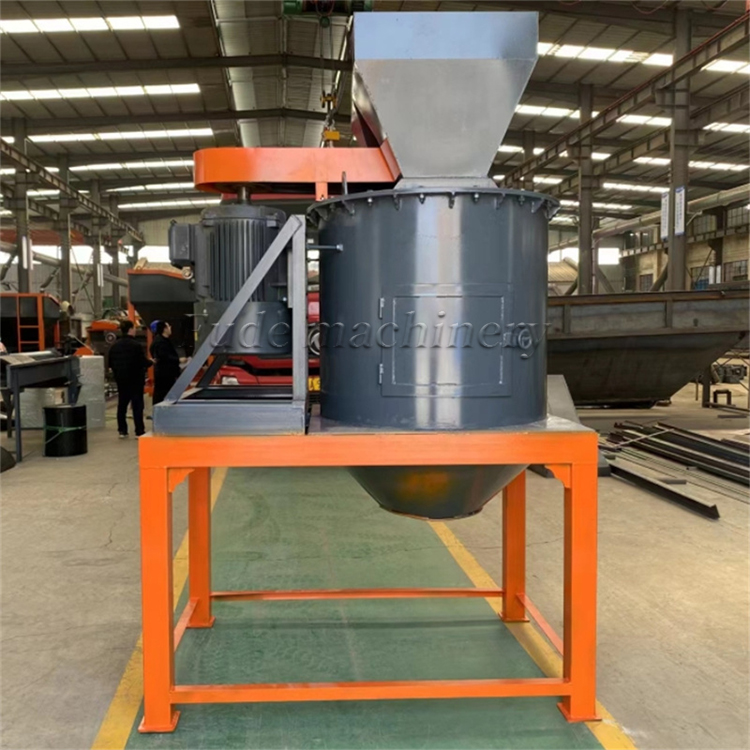
For producers who handle large volumes of compost, especially with fibrous content, the Vertical Crusher is a powerful and popular option. Like the Semi-Wet Crusher, this machine is also screenless and designed for high-moisture materials. However, its internal mechanism is different. It uses a series of chains attached to a rotor that spins on a vertical axis.
As material is fed into the top, these high-speed chains act like a flail, shattering the compost against the hardened steel inner walls of the crusher. This action is extremely effective at breaking down not only the compost but also any fibrous materials mixed in, such as straw or wood chips.
Best For: Large-scale composting, materials with high fiber content, breaking down lumpy compost.
Key Advantage: High throughput capacity and excellent performance on fibrous, tough materials. It is also screenless and clog-proof.
How it Works: A vertical rotor with high-speed chains violently shatters material against the inner walls.
This fertilizer crusher is a robust, heavy-duty machine built for the demanding environment of a commercial composting facility.
Quick Comparison: Which Fertilizer Crusher is for You?
Choosing can be tough, but it becomes much easier when you match the machine’s strengths to your specific raw material. Here is a simple table to help you compare the top options.
Feature
Semi-Wet Material Crusher
Hammer Mill Crusher
Vertical Crusher
What This Means For You
Ideal Moisture
High (20-50%)
Low (<15%)
High (20-50%)
This is the most critical factor. Match this to your material to avoid clogs.
Screen Design
Screenless (Clog-Proof)
Has a Screen
Screenless (Clog-Proof)
Screenless designs offer reliability and continuous operation with wet materials.
Best For
Sticky Manure, Sludge
Dry Powders, Chemicals
Fibrous Compost, Lumps
This helps you match the machine’s specialty to your exact input.
Primary Use
Organic Fertilizer Lines
BB / Chemical Fertilizer Lines
Large-Scale Composting
This shows where each fertilizer crusher fits in the broader industry.
Frequently Asked Questions
Question 1: What is the best fertilizer crusher for wet chicken manure? The best and only reliable choice is a Semi-Wet Material Crusher. Its screenless design makes it impossible to clog, which is the main problem when crushing wet, sticky materials like fresh chicken manure. Standard crushers with screens will clog within minutes.
Question 2: Can a hammer mill crusher be used for compost? A hammer mill crusher should only be used for very dry, finished compost with a moisture content below 15%. If the compost is even slightly damp or sticky, the hammer mill’s screen will clog. For most composting operations, a Semi-Wet or Vertical Crusher is a much safer choice.
Question 3: What is the main difference between a vertical and a semi-wet crusher? Both are screenless and good for wet materials. The main difference is the internal mechanism. A Semi-Wet Crusher uses two opposing horizontal rotors for in-air crushing. A Vertical Crusher uses a high-speed vertical chain that shatters material against the inner wall. The Vertical Crusher is often preferred for fibrous materials like straw-heavy compost.
Question 4: How do I choose the right size fertilizer crusher? The right size depends on your target production capacity, measured in tons per hour (TPH). As a manufacturer, we at Fude Machinery can help you calculate your needs and build a crusher with the correct motor power and chamber size for your specific output goals.
Summary and Recommendations
Choosing the right fertilizer crusher is a decision that will impact your plant’s efficiency for years. The most important step is to correctly identify your raw material—is it wet and sticky, or dry and brittle? For the vast majority of organic fertilizer producers, a screenless machine like the Semi-Wet Material Crusher or the Vertical Crusher is the correct choice. These machines are engineered to provide reliable, clog-free performance.
As a direct manufacturer, we have the experience and engineering capability to help you make the right choice. We can customize any of our crushers to provide a one-stop solution that fits perfectly into your production line. An investment in the right crushing technology is an investment in the long-term success of your business.
About Fude Machinery
We are Fude Machinery, a specialist manufacturer of organic fertilizer equipment located in Zhengzhou, China. Since 2015, our 8,000 square meter factory and team of 15 engineers have provided factory-direct, customizable equipment for every stage of fertilizer production. We have proudly served businesses in over 120 countries, offering robust machinery and full-service support.
Do you have questions about whichfertilizer crusher is right for you? Contact our expert team today for a free consultation and a competitive quote directly from the factory.
According to different classification conditions, fertilizer compost is divided into the following 5 categories: it is divided into aerobic composting and anaerobic composting. At present, this method is rarely used. The fermentation temperature o...
You have a large amount of organic waste, like animal manure or agricultural straw. You know it can be turned into valuable fertilizer. But piling it up and waiting for nature to take its course is slow, smelly, and inefficient. At Fude Machinery,...
In the production of mineral fertilizer pellets, granulation equipment plays a pivotal role in determining the final quality of the product. The choice of machinery and raw materials directly influences the effectiveness and efficiency of the fert...
In modern agrochemical production, potash fertilizers play a vital role in maintaining soil fertility and improving crop quality. As a fertilizer equipment manufacturer, we recognize the need for innovation and continuous improvement of our techno...
 Organic fertilizer equipment,organic fertilizer production line,organic fertilizer equipment factory