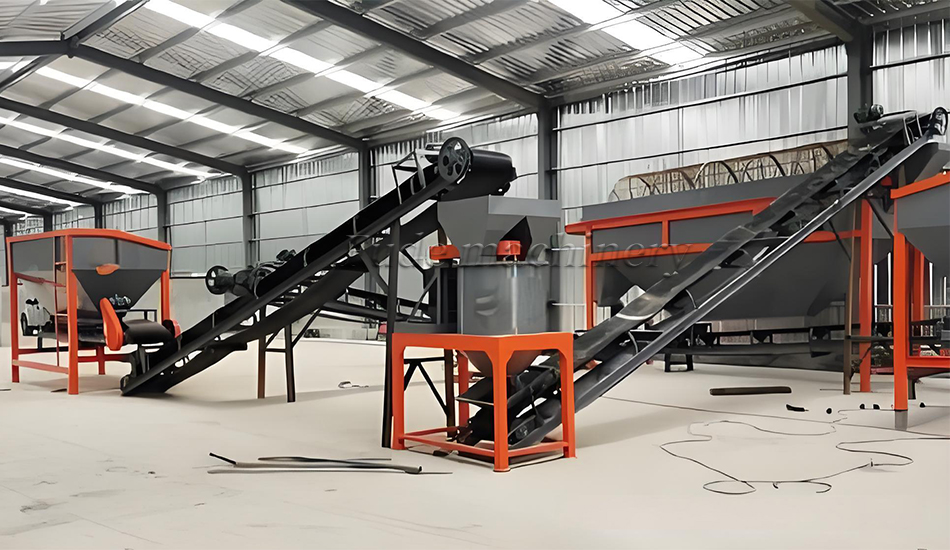
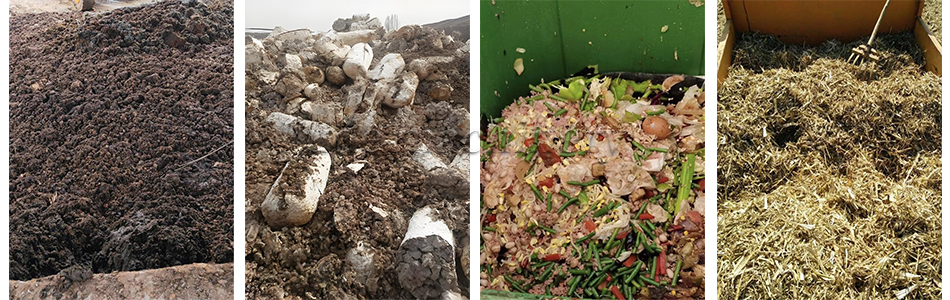
\As a fertilizer producer, you know that the quality of your raw materials is never consistent. Whether you are dealing with composted manure, crop residues, or mineral powders, you will always face clumps, cakes, and oversized particles. This is why selecting the right fertilizer crushing machine is not just an option—it is the critical first step to a successful and efficient production line. We are Fude Machinery, and we manufacture these machines. We want to share our expertise to help you avoid common, costly mistakes and make the best investment for your business.
Why Is Crushing the Foundation of Your Entire Production Line?
A fertilizer crushing machine is the gatekeeper to your entire operation, ensuring that only uniform, fine material proceeds to the next stage. Skipping this step or using the wrong machine is a direct path to production nightmares. Imagine trying to mix a cake batter that has large, hard lumps of flour in it. The final cake would be terrible. It is the exact same principle in fertilizer manufacturing. Large chunks of raw material do not mix evenly with other nutrients. This inconsistency creates serious issues.
This problem affects your entire process. Your granulator will struggle to form consistent pellets. The final product will look unprofessional and be less effective for farmers. More importantly, these lumps can cause physical blockages in your conveyors, mixers, and granulators. This leads to frequent shutdowns. It also increases strain on your motors and can result in expensive repairs. Investing in the right fertilizer crushing machinefrom the very beginning protects your other equipment. It guarantees a smoother, more profitable process from start to finish.
What’s the #1 Mistake to Avoid When Choosing a Machine?
The single most critical factor in selecting a fertilizer crushing machine is the moisture content of your material. This is the mistake we see new producers make most often. They assume all crushers are the same. They are not. A machine engineered to pulverize dry, brittle chemical powders will become hopelessly clogged within minutes if you try to feed it wet, sticky compost. This simple misunderstanding leads to constant downtime and frustration.
At Fude Machinery, our engineers have designed specialized machines precisely for this reason. The first question we always ask a client is: “What are your raw materials, and how wet are they?” The answer immediately narrows down the options and points to the correct solution.
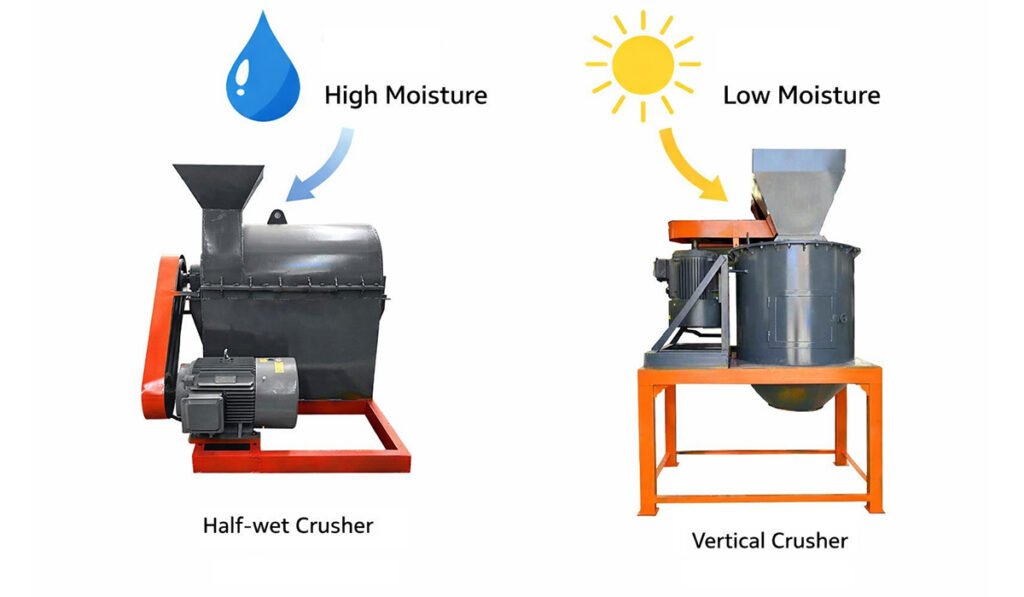
High Moisture (20-50%): You are in the world of organic materials like fresh manure, sludge, or green compost. You need a specific type of fertilizer crushing machine designed to handle this stickiness.
Low Moisture (Below 15%): You are likely working with chemical powders, minerals, or fully dried and cured compost. This requires a completely different crushing technology.
Choosing a machine without first considering moisture is the number one cause of production bottlenecks. It is a costly error that is very easy to avoid with the right information.
Which Crusher Is for Wet, Sticky Organic Materials?
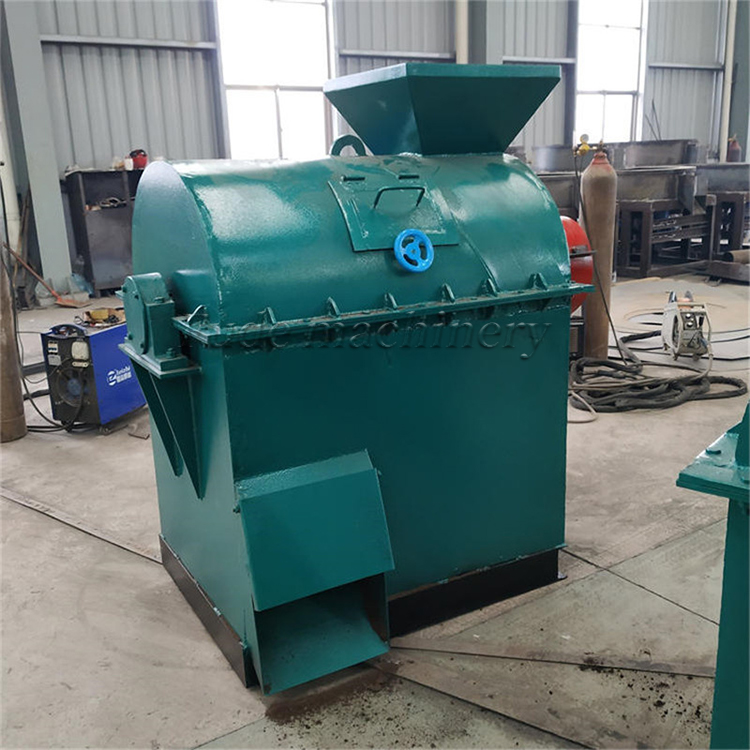
For wet, sticky raw materials like fresh compost or manure, the Semi-Wet Material Crusher is the best and often the only solution. The problem with wet material is that it sticks to everything. It is especially prone to sticking to the metal screens found in standard crushers, causing immediate clogs. Our Semi-Wet Material Crusher is ingeniously designed to be screenless. This key feature makes it virtually impossible to clog, even with the most difficult materials.
Here is how it works. Instead of one rotor, it has two that spin in opposite directions at high speed. As the wet material falls into the chamber, it is pulverized in mid-air by thousands of impacts from the rapidly rotating hammers. The resulting fine powder simply falls through the open bottom. There is no screen for the sticky material to build up on. This design is the key to its success. It makes this fertilizer crushing machine the workhorse for nearly every organic fertilizer plant we help build. If your material has moisture, this is the machine you need for continuous, worry-free operation.
Which Crusher Is for Dry, Brittle Chemical Materials?
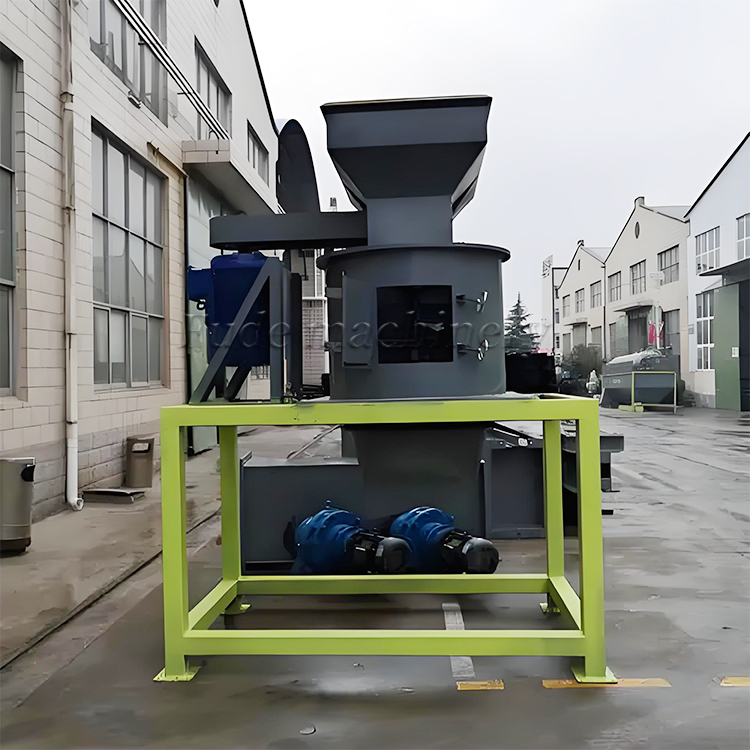
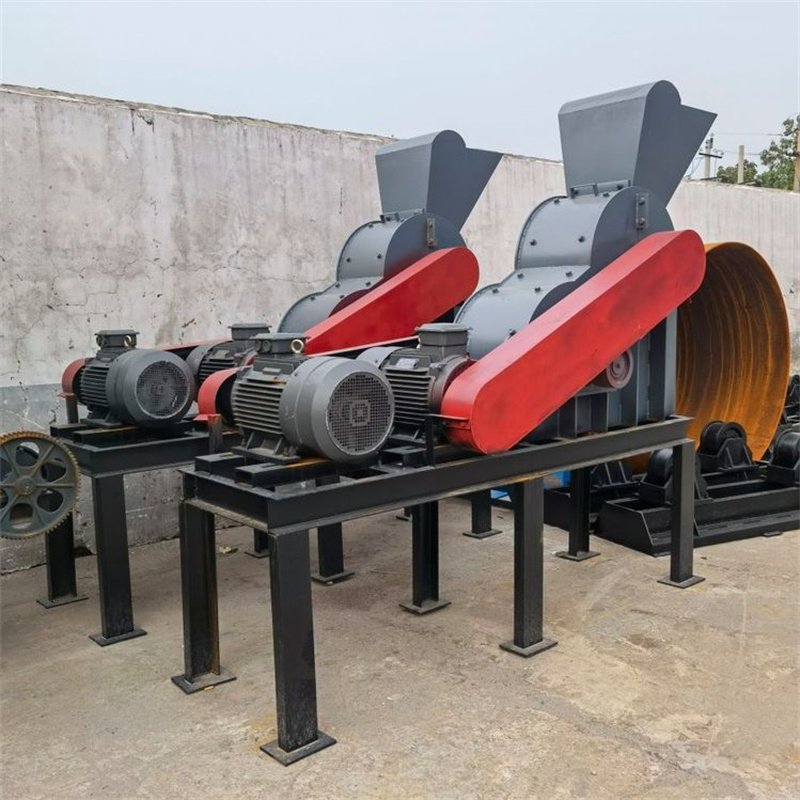
For dry, brittle materials like chemical powders (urea, potash), minerals, or fully cured compost, a Vertical Crusher or Chain Mill Crusher is the most efficient choice. These types of fertilizer crushing machine are built for high-speed pulverization of materials that do not stick together. The material is fed into the top and is immediately struck by hardened steel hammers or chains spinning at high velocity. The material shatters against the reinforced inner walls of the machine until it is a fine powder.
These crushers use a screen at the bottom to control the output size. Only particles that are small enough to pass through the screen can exit. This gives you excellent control over the final powder’s fineness. This precision is why they are the standard in NPK and compound fertilizer plants. They are also perfectly suited for the recycling loop in a production line. In this role, they re-crush any oversized granules that have been separated by the screening machine. They ensure that no material is wasted and that your final product is perfectly uniform.
Choosing the Right Machine for Your Material
Crusher Type
Best For Materials That Are…
Key Design Feature
Your Business Advantage
Semi-Wet Material Crusher
High-Moisture, Sticky, Organic (Manure, Compost)
Screenless, Dual-Rotor Design
Non-Clogging Performance. Ensures continuous operation without frustrating and time-consuming cleanouts.
Vertical / Chain Crusher
Low-Moisture, Brittle, Dry (Chemicals, Minerals)
High-Speed Impact with a Sizing Screen
Precise Particle Size Control. Guarantees a consistent, fine powder for superior mixing and granulation.
Cage Crusher
Medium-Hardness Materials (Phosphate Rock)
Impact Between Two Rotating Cages
Versatile for Compound Fertilizers. Handles a wide range of common chemical and mineral ingredients effectively.
2025 Trends: Smarter and Stronger Crushers
The world of fertilizer crushing machine technology is constantly improving. For 2025, the focus is on durability and intelligence. At Fude Machinery, we are leading this charge by incorporating advanced materials science. The hammers, chains, and liners inside a crusher are subject to intense wear. We are now using new manganese steel and chromium alloys that have a much higher resistance to abrasion. This means these critical parts last longer. For you, this means reduced maintenance costs and less downtime.
The second major trend is automation. Our latest models can be equipped with smart load sensors that monitor the electrical current drawn by the motor. If the machine starts to get overloaded, the system automatically slows down the infeed conveyor to prevent a jam. This ensures the crusher is always operating at its peak efficiency. It does this without needing an operator to constantly watch it. This smart technology maximizes your throughput and protects your investment in our fertilizer crushing machine.
Frequently Asked Questions
Question 1: What is the most important factor when choosing a fertilizer crushing machine? The single most important factor is the moisture content of your raw materials. Wet, sticky materials like fresh compost require a specialized screenless crusher, such as a Semi-Wet Material Crusher, to prevent clogging. Dry, brittle materials work best with a machine like a Vertical or Chain Mill Crusher.
Question 2: Can one machine handle all types of fertilizer materials? No single machine is ideal for all materials. A machine designed for dry chemical powders will quickly clog with wet organic waste. This is why it is critical to select a fertilizer crushing machine based on the specific properties of your raw materials to ensure efficient and reliable operation.
Question 3: How does crushing improve the quality of my fertilizer? Crushing creates a fine, uniform powder. This allows for better and more even mixing with other nutrients. When you feed this uniform powder into a granulator, you produce consistently sized, high-quality fertilizer granules, which are more valuable and effective for end-users.
Question 4: What is the main advantage of buying from a direct manufacturer like Fude Machinery? Buying directly from us means you get a more competitive price and the ability to customize the equipment. Our engineers can modify the machine’s size, materials, and power to perfectly match your production needs, ensuring you get the most efficient and durable solution for your plant.
Summary and Recommendations
Choosing the right fertilizer crushing machine starts with your raw material. Ask one key question: is it wet and sticky, or dry and brittle? This answer determines the right equipment and helps you avoid blockages, downtime, and unnecessary costs.
For high-moisture organic materials, the Semi-Wet Material Crusher offers smooth, clog-free crushing. For dry compound or NPK powders, the Vertical Crusher or Chain Mill Crusher delivers stable, efficient performance.
At Fude Machinery, we focus on complete, one-stop solutions. By fully understanding your process, we provide customized crushing equipment that forms a solid foundation for your fertilizer production line.
Ready to build an efficient and reliable production line? Contact our expert team today for a free consultation and a detailed quote on the perfect fertilizer crushing machine for your business.
The organic fertilizer production line is a production equipment that converts organic waste into efficient organic fertilizers. It has a wide range of applications and is important, mainly reflected in the following aspects: ...
The working principle of a horizontal mixer mainly involves the following aspects: The horizontal mixer is mainly composed of a U-shaped barrel, spiral mixing blades, and transmission components. This structural design ensures that the mi...
Nowadays, as an increasing number of start-up companies join the animal feed manufacturing industry, chicken feed pellet mills occupy a place in the feed pellet production market with their obvious advantages of small size, low cost, low investme...
Pomace fertilizer production offers an effective way to recycle high-moisture organic waste, transforming it into valuable products for agricultural use. The choice of drying method plays a critical role in determining the quality of the final fe...
 Organic fertilizer equipment,organic fertilizer production line,organic fertilizer equipment factory